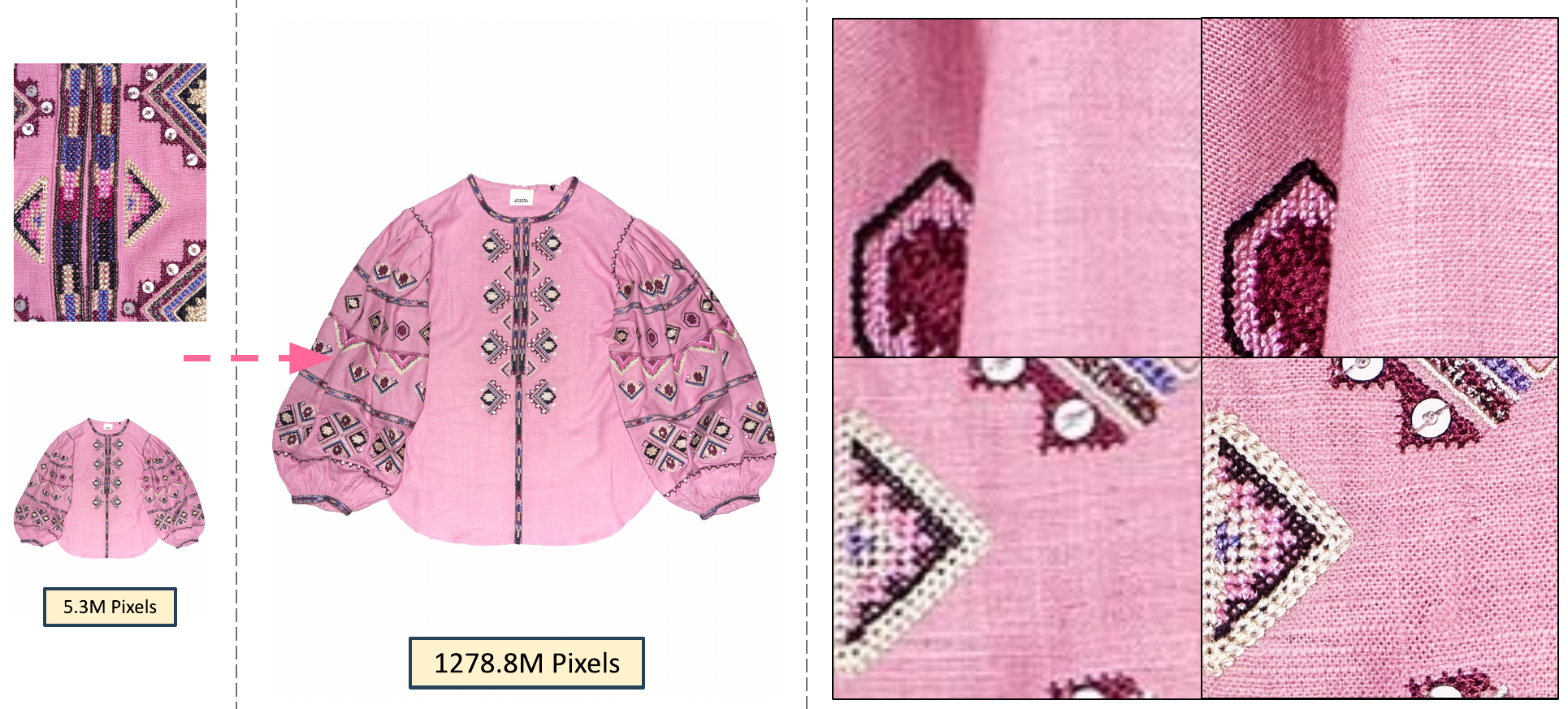
The interactive viewer showcases a single real-world example captured by us. Due to copyright restrictions, we are unable to host additional product images publicly. Please refer to the Gallery Viewer for patch-level results across a diverse set of garments.
We present GarmentZoom, a system that enhances the full-view photo to match the fidelity of its accompanying close-up, enabling seamless zoom-and-pan exploration. Unlike standard reference-based super-resolution, our setting involves close-up references that are spatially unaligned with the full view, and scale factors that vary substantially across garments (3–20×). Prior work typically relies on alignment to transfer details or requires per-instance fine-tuning to memorize them. Instead, we curate a high-quality apparel dataset from real product listings and train a single model that supports a continuous range of scales across diverse garments. Our approach synthesizes details without requiring spatial alignment and matches the quality of per-instance methods with a fraction of the training cost.
Our system consists of three stages: Dataset Construction, Architecture, and Full-Resolution Inference.
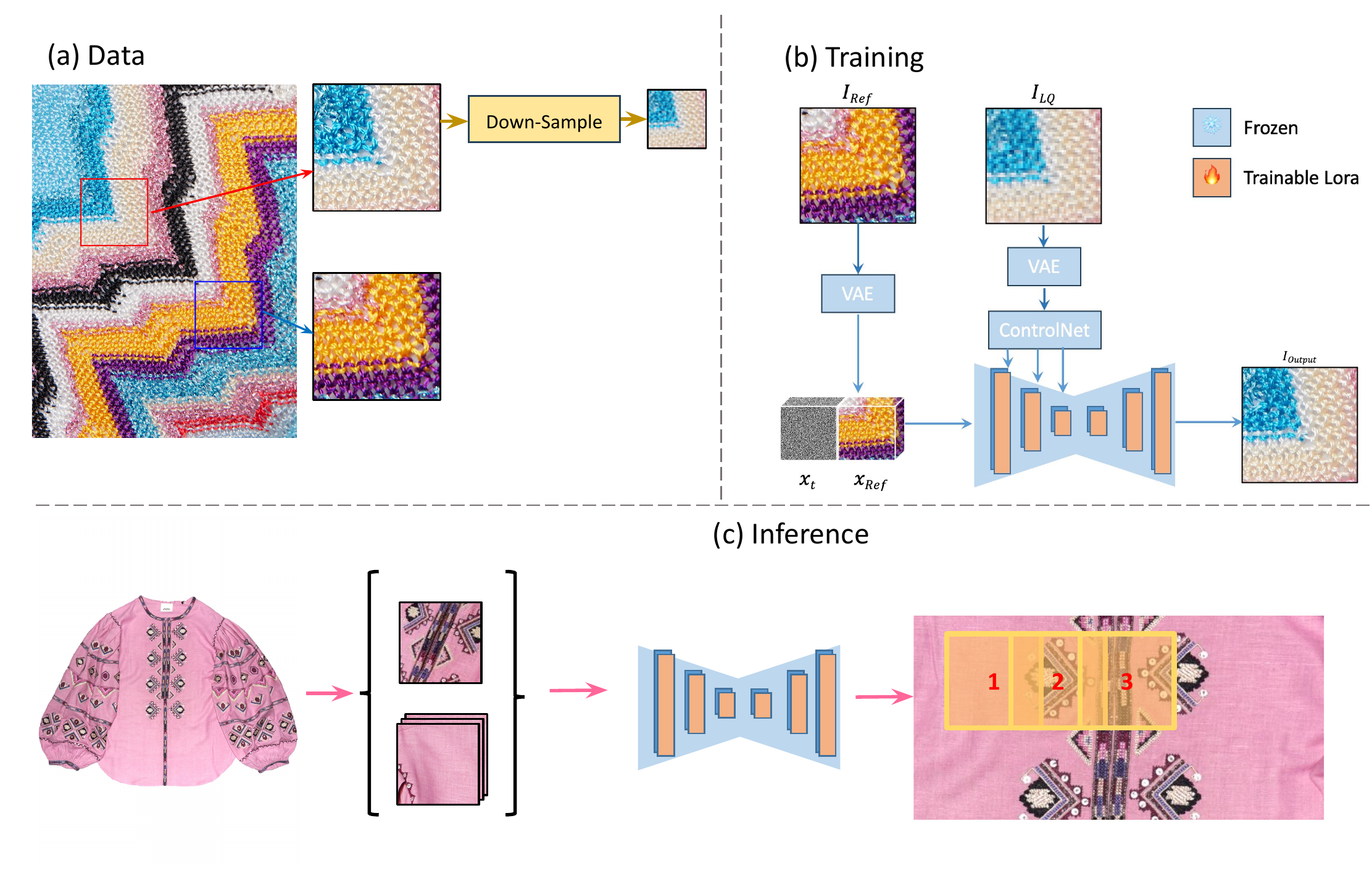
We synthesize supervised training triplets (ILQ, IRef, IGT) from high-resolution close-up images. For each close-up, we sample two spatially separated crops: one serves as the reference IRef, and the other as the ground-truth target IGT. Spatial separation discourages trivial copying, encouraging the model to use the reference as a texture cue. We obtain the low-quality input ILQ by downsampling IGT with a random continuous scale factor s ∈ [3, 20], matching the resolution gaps observed in real listings. We also use a vision–language model to generate a detailed text description for each garment as auxiliary conditioning.
Our method is built on FLUX.1-dev in conjunction with a 4× single-image super-resolution ControlNet. We condition generation on low-level texture features from a reference image by concatenating a VAE-encoded reference (xRef) with the noisy latent (xt). To differentiate the conditioning signal from the generation target, we apply distinct timestep embeddings: T=0 for xRef and T=t for xt. This enables bidirectional attention between the two streams, facilitating reference-guided synthesis. For efficient fine-tuning, we employ a lightweight LoRA adapter on the flow-matching model, keeping the VAE, text encoders, and ControlNet weights frozen.
While directly generating the full-resolution output is infeasible due to GPU memory constraints, we adopt a sliding-window inference strategy, performing inference on overlapping windows and averaging the overlapping latent regions on a unified canvas. To mitigate boundary artifacts from repeated window edges, we introduce sliding windows that vary in position at each inference timestep. This yields seamless, artifact-free outputs across the entire garment.
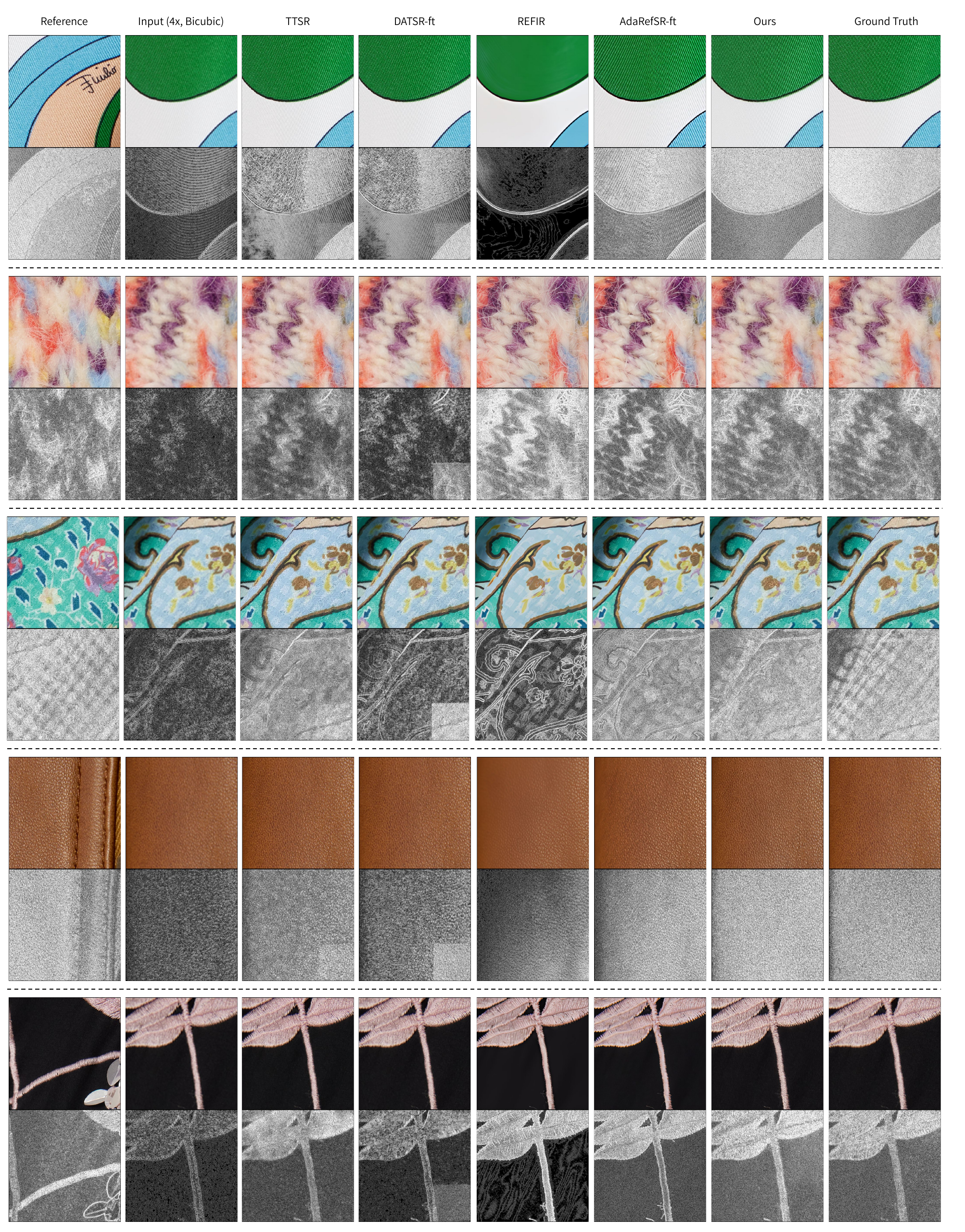
We compare GarmentZoom with four baselines (TTSR, DATSR, ReFIR, ContinuousSR) across garment examples at varying scale factors. Each row shows a different garment; columns show the full-view input, the low-resolution crop, baseline results, and our output alongside the unaligned reference crop.
Qualitatively, GarmentZoom achieves the highest visual fidelity and consistency with the reference texture. General-purpose arbitrary-scale models struggle due to domain gaps in scale and field of view. Reference-based baselines that rely on spatial alignment fail when the close-up and full-view images exhibit significant appearance differences (e.g., viewpoint change, lighting variation). Our approach synthesizes training pairs entirely from the close-up without requiring alignment, yielding sharp, detail-consistent results across the full range of scales.
Our method generalizes across scale factors. Browse results at 4×, 10×, 15×, and 20× downsampling.
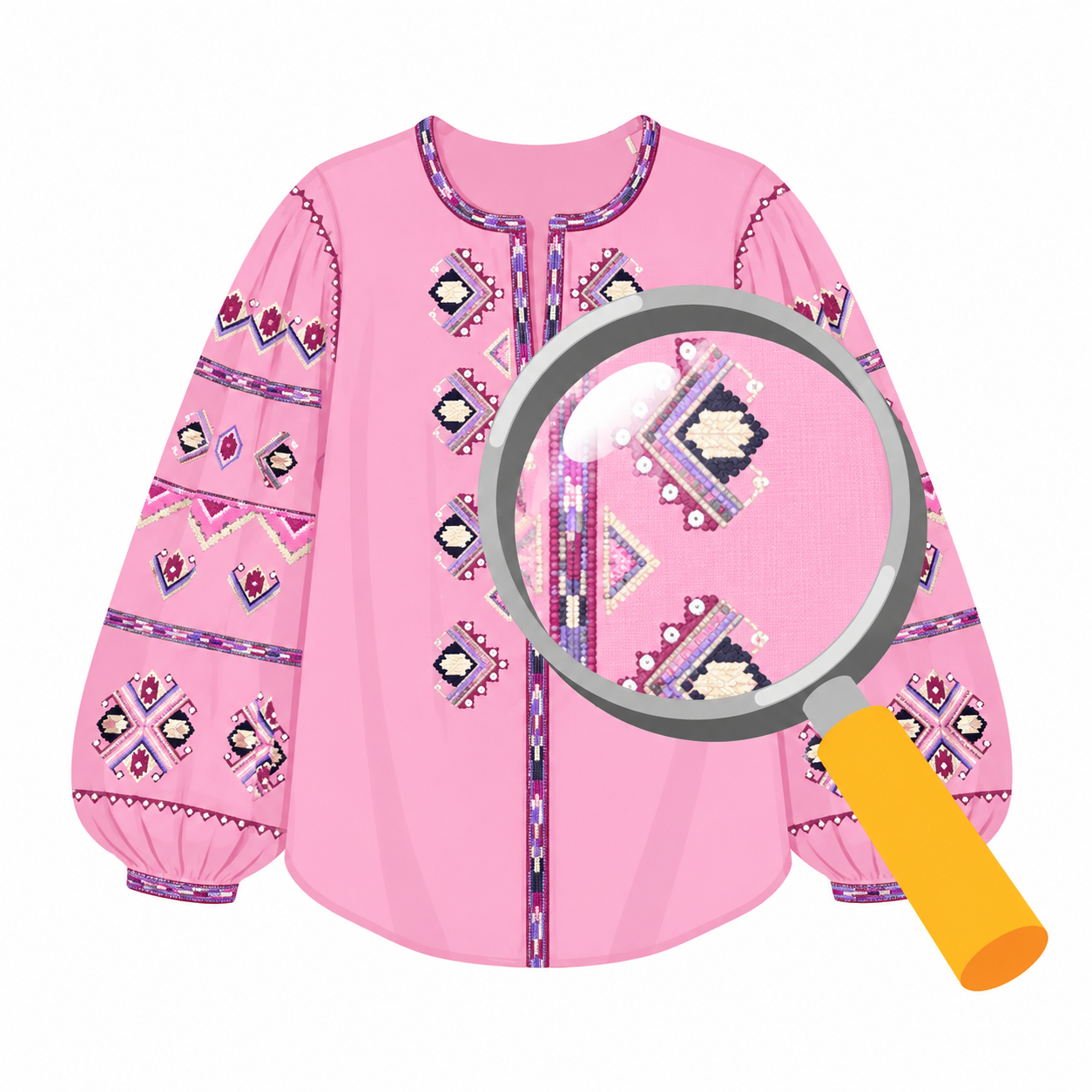 GarmentZoom: Generating Zoomable Images from Garment Listings